
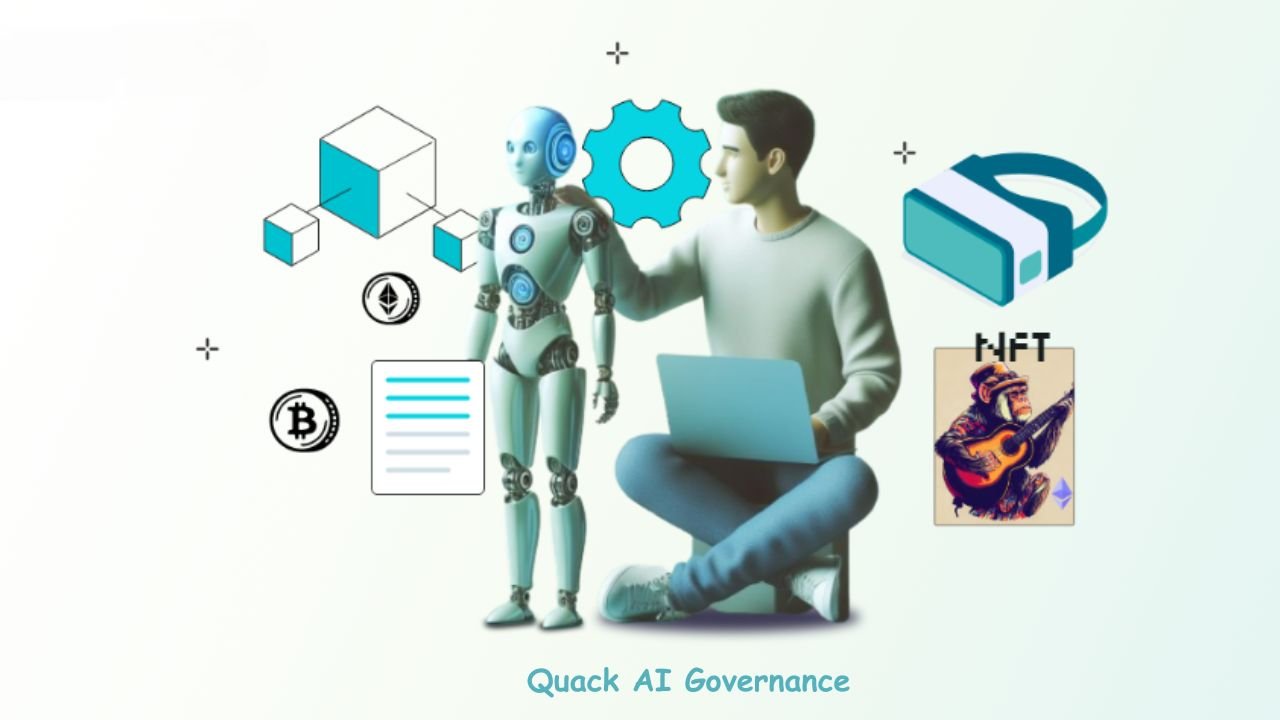
Do you feel like your Decentralized Autonomous Organization (DAO) is moving too slowly? It’s a common issue in the Web3 world. Manual voting systems, slow proposal reviews, and inconsistent participation often create gridlock. Important decisions take weeks to pass, while the crypto market changes within minutes. This challenge is not just an inconvenience—it’s a fundamental flaw in how decentralized governance currently operates. The reality is that less than 10% of token holders usually take part in DAO voting. That means most people in the community stay silent, and decisions get delayed. This is the systemic problem that Quack AI Governance is designed to solve. It brings artificial intelligence into Web3 to make governance faster, fairer, and fully automated.
With Quack AI, decentralized governance transforms from a manual bottleneck into an intelligent, self-running system. Let’s explore how this innovation is changing the way DAOs make decisions, grow faster, and operate efficiently.
What is Quack AI Governance?
Put simply, Quack AI Governance is an intelligent AI-based solution that can assist decentralized organizations in making more and faster decisions. Quack AI eliminates the need to use human voters to read, analyze, and make a decision on each proposal manually, but instead it employs autonomous AI agents to do it automatically.
In a DAO, all the token holders are normally required to vote manually. However, this is hard to do as the community grows. Citizens become bored with reading long projects and make repetitive voting, which causes voter fatigue. Quack AI governance rectifies this by enabling AI agents to read proposals, comprehend discussions, conduct risk analysis, and make decisions in real-time depending on the preset rules of the community.
This implies that there are no human delays when it comes to 24/7 governance. It makes the DAO efficient, scalable, and continuously active, even when its members are offline.
What is Unfair and Sluggish about Traditional DAOs?
The two significant issues with traditional DAOs are speed and fairness.
First, the pace at which the decision is taken is very slow. Community members argue over a proposal on the course of weeks, and by the time a decision is reached, the market could have changed.
Second, justice is usually diminished. The individuals who possess a large number of tokens, which is commonly known as whales, are more powerful in voting in most DAOs. This brings about inequality whereby the small group of the rich, who will be the holders, will dictate the governance process, which will advance their interests at the expense of the community.
These two problems are addressed by Quack AI Governance. It operates under AI agents that operate under clear, rule-based logic as opposed to human-related emotion and influence. These agents calculate and make objective judgments. It is also based on preference-based delegation, i.e., users are able to delegate their votes to AI agents that serve according to their own preferences. This will guarantee equal participation for all and not just the largest investors.
Consequently, decision-making is quicker, qualitative, and unmanipulated.
How Does Quack AI Automate Web3 Decision-Making?
The intelligent automation is the primary strength of Quack AI Governance. It not only logs votes, but it can comprehend propositions and make decisions based on smart contracts.
Quack AI relies on agentic AI, which is a form of artificial intelligence with the ability to take action on complex objectives independently. These agents process all the proposal analysis and risk evaluation and are automatically executed on the blockchain.
To the point, Quack AI introduces an intelligent brain into decentralized ruling.
The AI Delegation Model
Quack AI governance is based on the AI Delegation Model. In this case, token holders will be able to predetermine their voting options. One just needs to inform the AI agent on how they would wish it to vote on certain issues or approaches and it will do so on your behalf.
Imagine a professional manager of your tokens of governance. The AI adheres to your predefined logic so that your voice will be constantly on- even when you are not online.
In a bid to make the system more inclusive, the users are awarded Governance Certificates by engaging with the Quack AI platform. Such certificates are convertible into the power of governance. It is expected that in the near future, even the small holders who do not hold many tokens can have a significant voice. It is a move towards actual decentralization, where everyone has an equal opinion.
Intelligent Proposal Analysis and Automated Execution
The Proposal Engine is one of the most remarkable items of Quack AI. This engine was already in operation before the commencement of voting. It will scan proposals, community discussion, and blockchain data to classify the idea as strong, risky, or beneficial.
This pre-analysis provides smart suggestions to the DAO to enable the community to make wise decisions.
After the decision is made, Quack AI then does all the rest automatically. It transfers money, allocates rewards, and changes ownership shares- all built on smart contracts.
The system is also integrated with leading blockchains such as Ethereum, Solana, and Arbitrum, and enables DAOs to plan activities across ecosystems at a single location.
Traditional DAO vs. Quack AI Governance
| Feature | Traditional DAO Governance | Quack AI Governance |
| Decision Speed | Very slow (weeks of debate) | Instant and real-time |
| Voter Participation | Low (under 10%) | High (AI agents ensure constant participation) |
| Fairness | Often controlled by whales | Equal participation through AI delegation |
| Voting Method | Manual on-chain voting | Automated AI-based governance |
| Execution | Requires human confirmation | Fully automatic via smart contracts |
Where Can Quack AI Governance Be Used?
Because of its modular structure, Quack AI governance can easily be added to different types of Web3 projects. It fits into DeFi, Real-World Asset (RWA) tokenization, and multi-chain coordination.
1. DeFi Protocol Optimization
In Decentralized Finance (DeFi), timing is everything. The market changes in seconds, and DAOs can’t afford delays. Quack AI governance automates treasury management, fund allocation, and risk response.
Its AI agents can review funding requests, predict outcomes using historical data, and make real-time decisions to protect liquidity and maximize growth. This keeps DeFi platforms both secure and profitable.
2. Real-World Asset (RWA) Integration
When real-world assets like real estate or gold are tokenized, compliance and auditability become crucial. Quack AI governance helps by keeping all legal and financial records on-chain.
This ensures that every transaction is transparent, traceable, and verifiable. It builds trust between investors and institutions, allowing the RWA market to scale responsibly.
3. Cross-Chain Coordination
Many DAOs operate on multiple blockchains, and coordinating them is often complicated. Quack AI solves this by connecting different blockchains and making decisions automatically across them.
For example, an environmental DAO could vote on Ethereum, Solana, and Polygon simultaneously through Quack AI’s AI-mediated voting, ensuring consistent decisions across all networks.
Trust and Transparency
The biggest challenge with AI is trust. How can people trust AI agents to make fair decisions?
Quack AI governance handles this with verifiable explainability. Every decision made by an AI agent is stored transparently on the blockchain. Anyone can trace how a decision was made and verify its logic.
It also includes cryptographic proofs and anomaly detection systems that double-check every action before execution. This makes the system reliable and secure. It ensures that no biased or manipulated decisions are carried out without verification.
The Quack AI Governance App and Price
Quack AI also offers a user-friendly app that makes governance simple for everyone, even beginners. Through the app, you can delegate your voting power, monitor proposals, and track on-chain activities in real time.
The ecosystem utilizes a native utility token referred to as Q, which can be traded as a governance and staking token. Participants are able to stake Q to support AI agents with the prospect of earning rewards.
The Quack AI governance price is subject to some fluctuation; however, the economic model is intended to support fairness and transparency on the platform. Staking and governance certificates will account for all actions taken, while economic disincentives will reduce the potential for malicious and harmful behavior in the ecosystem and platform.
Conclusion
Quack AI Governance represents a massive step forward for decentralized systems. It fixes the biggest pain points of DAOs—slow decisions, low participation, and unfair influence—by replacing manual work with intelligent automation.
With its advanced AI agents, verifiable transparency, and cross-chain capability, Quack AI is not just another blockchain tool; it’s the foundation for the next generation of decentralized governance.
As Web3 continues to evolve, Quack AI Governance ensures that DAOs stay fast, fair, and future-ready. It’s time to move beyond endless voting delays and let AI governance transform decentralized organizations into intelligent, self-running systems.
FAQs
- What is Quack AI Governance?
It is an AI-powered blockchain protocol that automates proposal analysis, voting, and execution for DAOs, making decentralized decision-making faster and more efficient. - How does Quack AI solve voter apathy?
It allows users to delegate their voting power to AI agents based on preferences, ensuring constant participation even when members are inactive. - Is Quack AI transparent?
Yes. Every AI decision is recorded on-chain and backed by cryptographic proofs, allowing full auditability and trust. - What are its main use cases?
DeFi treasury management, Real-World Asset tokenization, and cross-chain coordination. - What are Governance Certificates?
They are digital rewards that give users voting rights based on participation, not just token ownership—ensuring fairness for all.
Also Read About: SinkNews com – A New Way to Stay Updated with the Latest News and Trends